
Inside the Mountain: AUS-ROV Completes Hydroelectric Tunnel Inspections at AGL Bogong Power Station
Deploying the purpose-built Maestro tunnel inspection ROV into the Bogong–Mackay Tunnel and the Mackay Power Station Headrace Tunnel — two critical water conduits powering 140 MW of generation capacity in Victoria’s Alpine National Park.
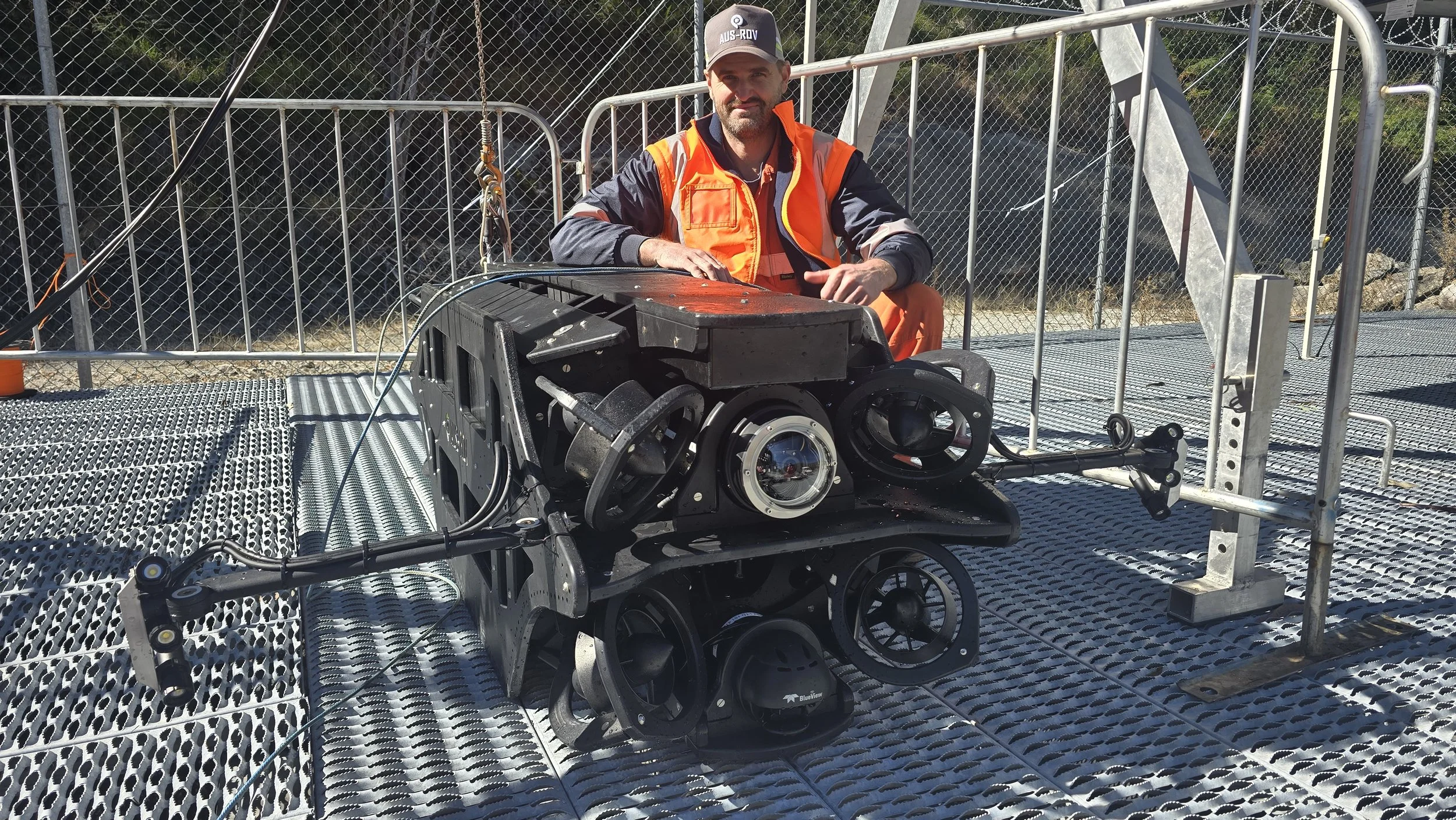
AUS-ROV Underwater Inspections has successfully completed internal condition assessments of two critical water conveyance tunnels at AGL Energy’s Bogong Power Station, located deep within Victoria’s Alpine National Park. The scope encompassed the Bogong–Mackay Tunnel and the Mackay Power Station Headrace Tunnel — infrastructure that feeds water from the Bogong High Plains down to twin 70 MW Francis turbines on the shores of Lake Guy.
The project presented a significant technical challenge. These are not open-water environments — they are long, fully submerged, confined conduits that form the arterial supply of one of Victoria’s key peaking hydroelectric facilities. With a combined generation capacity of 140 MW and the ability to respond rapidly to peak demand on the National Electricity Market, any inspection programme on these assets demands meticulous planning, specialist equipment and a clear understanding of the operational risks involved.
The Challenge
Hydroelectric tunnel inspections sit at the intersection of several technical disciplines: confined-space ROV operations, condition assessment of ageing infrastructure, and the operational constraints of a live power generation asset. The Bogong headrace tunnel extends approximately 6.5 kilometres at around 5 metres in diameter, running from the intake at Lake Guy to the power station. The tunnel was constructed as part of a $240 million project commissioned in 2009, and periodic internal inspection is essential to verify the structural integrity of the concrete lining, identify any deformation, cracking, joint deterioration or siltation, and confirm that the conduit remains fit for continued service.
Operating an ROV inside a tunnel of this length introduces challenges that don’t exist in open-water work. There is no GPS, no surface reference, limited ability to recover equipment in the event of an entanglement, and the ever-present consideration that the tunnel is a single point of failure for the power station’s water supply. A stuck ROV doesn’t just mean lost equipment — it can mean an obstruction in a critical conduit, with flow-on consequences for generation availability.
The Maestro: Purpose-Built for Confined Spaces
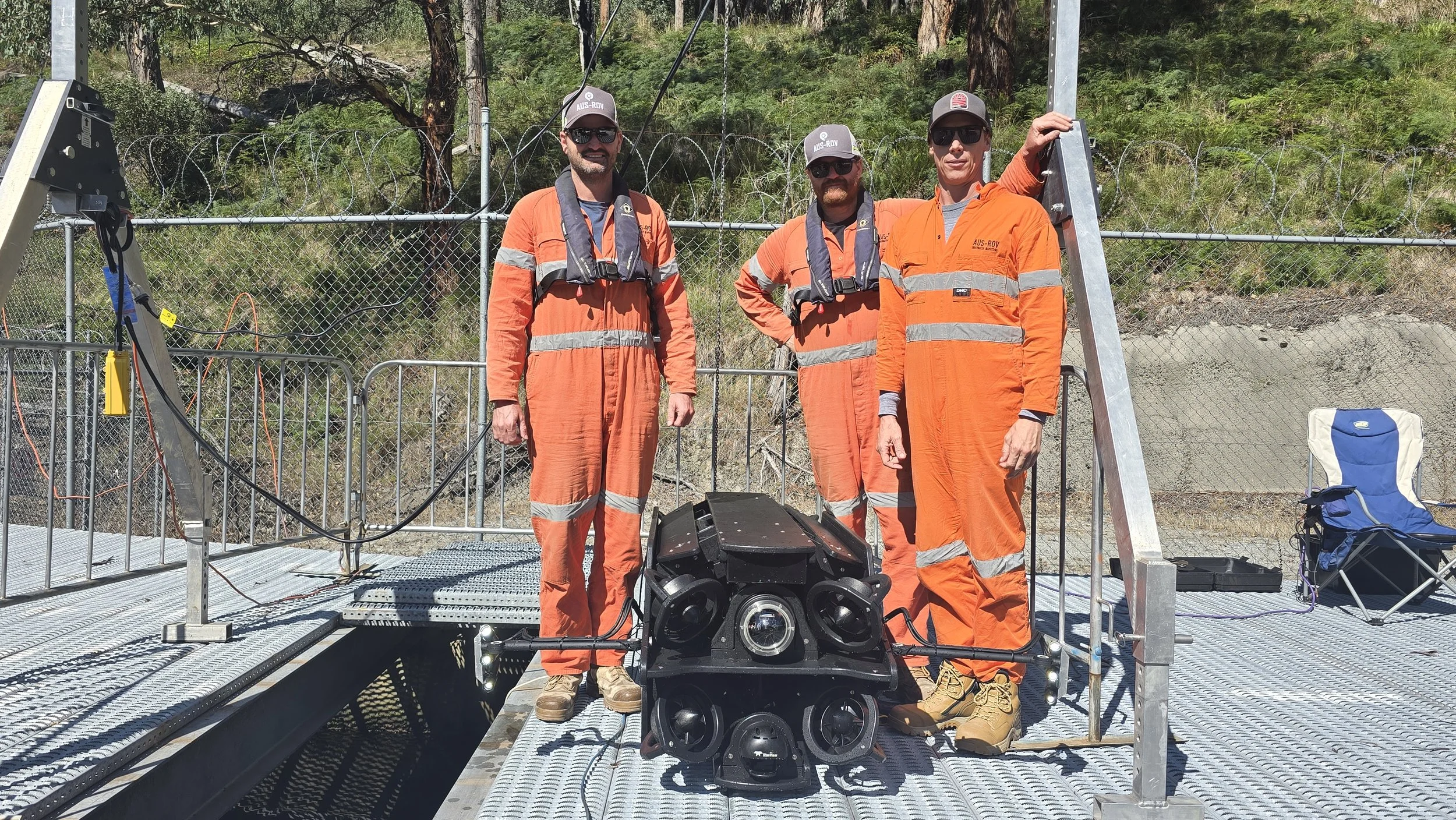
AUS-ROV deployed the Maestro, a tunnel inspection ROV designed and assembled in-house specifically for long-distance confined-space operations. The Maestro is not an off-the-shelf observation-class vehicle repurposed for tunnel work — it was engineered from the ground up for this exact operating environment.
PLATFORM
The vehicle’s tether management system is central to safe confined-space deployment. In a 6.5-kilometre tunnel, the umbilical isn’t just a power and data conduit — it’s the only physical connection back to the surface, and the only means of recovering the vehicle if propulsion is lost. The Maestro’s tether system is designed to minimise drag and snag risk while maintaining full telemetry and HD video transmission over the entire deployment length.
For the Bogong inspection, the Maestro was configured with forward and rear-facing HD cameras, high-intensity LED lighting arrays capable of illuminating the full tunnel bore, and multibeam sonar for capturing dimensional data on the tunnel profile. This sensor suite enables the AUS-ROV team to build a comprehensive picture of internal condition — from visible defects such as cracking, spalling and joint displacement through to geometric changes in the tunnel cross-section that might indicate structural movement or deformation over time.
Execution and Methodology
The inspection programme was executed in close coordination with AGL’s operations and engineering teams. Tunnel dewatering and isolation protocols were managed by AGL to provide safe access, while AUS-ROV managed the ROV deployment, piloting and data acquisition.
Each tunnel was inspected systematically, with the Maestro advanced at a controlled pace to ensure complete visual coverage of the tunnel lining. The ROV pilot maintained continuous assessment of the operating environment, with standing authority to halt or reverse the vehicle at any point where conditions presented an unacceptable risk to equipment or mission success. This operational discipline is non-negotiable in confined-space work — the consequences of pushing beyond a safe limit in a 6.5-kilometre tunnel are orders of magnitude more severe than in open water.
Throughout both inspections, the AUS-ROV team captured continuous HD video footage, geo-referenced still images at regular intervals and at all identified features of interest, and sonar data for tunnel profiling. All data was logged against chainage to enable precise defect location and future comparison surveys.
“Confined-space tunnel inspection requires a different mindset to open-water ROV work. Every metre forward is a metre you need to safely come back from. The Maestro was built for exactly this — getting in, capturing the data, and getting out with the vehicle and the dataset intact.”
— AUS-ROV Operations Team
Outcomes and Deliverables
Both the Bogong–Mackay Tunnel and the Mackay Power Station Headrace Tunnel were inspected in full, with the Maestro deployed and recovered safely on each run. The project was completed with zero safety incidents, zero equipment losses, and complete inspection coverage of both conduits.
AGL received a comprehensive inspection deliverables package including annotated HD video of both tunnels, a full defect log with chainage references and severity classifications, high-resolution still imagery of all identified features, sonar profile data for comparison against as-built dimensions, and a formal condition assessment report providing AGL’s engineering team with the information needed to inform their ongoing asset management decisions.
The successful completion of this project demonstrates that long-distance hydroelectric tunnel inspections can be executed safely and efficiently using purpose-built ROV technology, providing asset owners with the internal condition data they need without resorting to more invasive and costly inspection methods such as manned entry or full dewatering programmes.
Why It Matters
Australia’s hydroelectric fleet is ageing. Many of the tunnels, penstocks and conduits that feed the country’s hydro stations were constructed decades ago, and periodic internal inspection is critical to maintaining safe, reliable generation. As these assets take on an increasingly important role in providing firming capacity and dispatchable generation to support the energy transition, the ability to efficiently assess their internal condition becomes even more important.
ROV-based inspection offers a compelling alternative to traditional methods. It eliminates the need for personnel to enter confined, hazardous spaces. It can be executed during shorter planned outage windows, reducing the time the asset is offline. And it produces a permanent digital record that can be compared survey-to-survey to track deterioration trends over the life of the asset.
AUS-ROV’s investment in designing and building the Maestro specifically for this application reflects a commitment to capability that goes beyond adapting off-the-shelf equipment. When the tunnel is 6.5 kilometres long, 5 metres in diameter, and sits underneath a national park feeding a 140 MW power station, the equipment needs to be built for the job.
Planning a Tunnel or Pipeline Inspection?
AUS-ROV provides specialist ROV inspection services for hydroelectric tunnels, water supply conduits, penstocks, pipelines, outfalls and other confined underwater infrastructure across Australia and internationally.
Contact us: info@aus-rov.com.au | www.aus-rov.com.au